

Orchestrating a Team of AI Agents Effectively for Academic Research
Frontiers of Co-Intelligence Education Forum
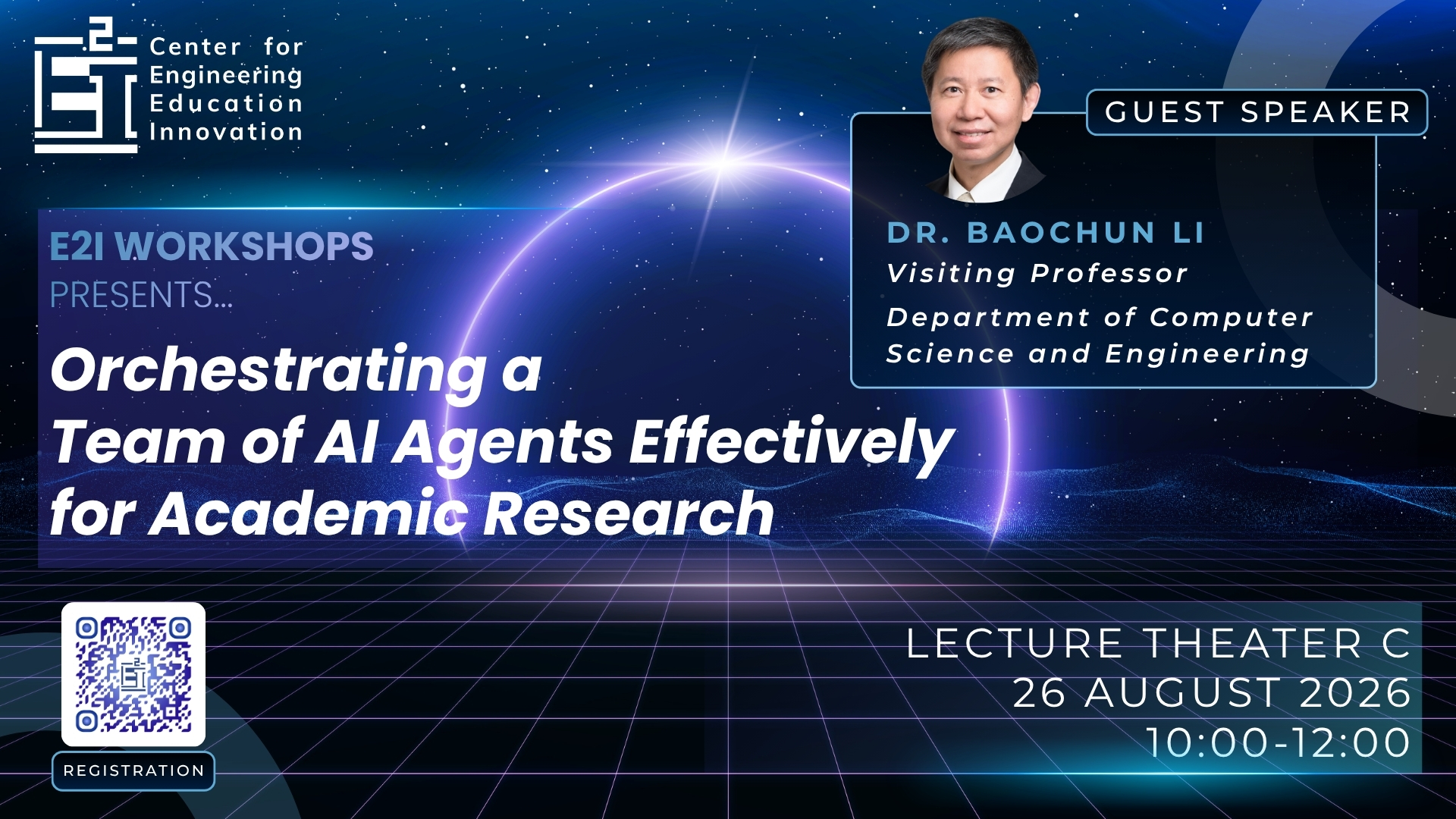
26 Aug 2026 (Wed)
10:00am - 12:00pm
LT-C, HKUST
Dr. Baochun Li, Visiting Professor, Department of Computer Science and Engineering
Forum Overview:
AI agents will soon become some of the most essential tools for accelerating academic research projects — ranging from selecting topics and designing core ideas to running experiments and writing papers. Yet, due to inherent limitations of these agents, we should avoid relying on agents for every decision-making process. In this workshop, I will show how these agents can be best utilized for all stages in research, and how we can collaborate with agents in the most effective way possible. Using a combination of slide presentations and live demos, I will share some of my most recent experiences over the past two months working with agents to write research papers. I will show how we can accelerate the pace of making progress by an order of magnitude, while mitigating the “cognitive debt” that accumulates due to such an accelerated pace.
Bio:
Baochun Li received his B.Engr. degree from the Department of Computer Science and Technology, Tsinghua University, China, in 1995 and his M.S. and Ph.D. degrees from the Department of Computer Science, University of Illinois at Urbana-Champaign, Urbana, in 1997 and 2000. Since 2000, he has been with the Department of Electrical and Computer Engineering at the University of Toronto, where he is currently a Professor. He holds the Bell Canada Endowed Chair in Computer Engineering since August 2005. His current research interests include cloud computing, security and privacy, distributed machine learning, federated learning, and networking.
Dr. Li has co-authored more than 500 research papers, with a total of over 29000 citations, an H-index of 92 and an i10-index of 374, according to Google Scholar Citations. He was the recipient of the IEEE Communications Society Leonard G. Abraham Award in the Field of Communications Systems in 2000, the Multimedia Communications Best Paper Award from the IEEE Communications Society in 2009, the University of Toronto McLean Award in 2009, the Best Paper Award from IEEE INFOCOM in 2023, and the IEEE INFOCOM Achievement Award in 2024. He is a Fellow of the Canadian Academy of Engineering, a Fellow of the Engineering Institute of Canada, and a Fellow of IEEE.